2026 - Volume #50, Issue #2, Page #35
[ Sample Stories From This Issue | List of All Stories In This Issue | Print this story
| Read this issue]
CV Joint Repair Tip Avoids Replacement
 |
 |

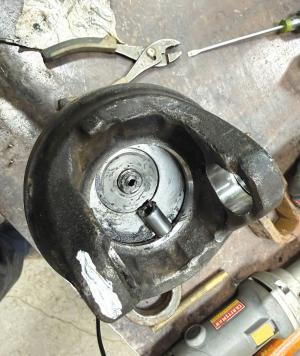
“Drive lines used prior to CV joints were more reliable and cheaper to buy and repair,” says Gutschmidt. “If the peg in the joint breaks off, that usually means $1,500 out of the farmer’s pocket. I think they were made to fail, costing the customer money and downtime. They’re just another way to suck money out of customers.”
Gutschmidt’s solution to the problem is careful welding and reinforcement to reduce future problems.
“Usually, the piece that breaks off is about 1 in. long and 1/2 in. in diameter,” says Gutschmidt. “It has a 3/16-in. hole in the center for grease.”
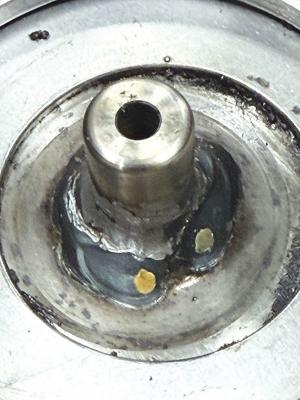
After grinding off the base of the peg to make room for his weld, Gutschmidt aligns the peg using a 3/16-in. drill bit in the center hole.
“The weld flows nicely, and when I finish, I touch up the base with a die grinder,” he says. “I leave the drill bit in place but cut it off level with the top of the peg. It adds reinforcement, and the grease can still get through its spirals.”
Gutschmidt notes that the welding and reaming take only about 10 min.
“My customer put the U-joint crosses back together on his bale shredder,” he says. “It was a cheap repair for the customer, and the shredder is still going strong.”
Contact: FARM SHOW Followup, Roger Gutschmidt, Gutschmidt Manufacturing, 202 Elm St. E., Box 311, Gackle, N.D. 58442 (ph 701-269-0537).
Click here to download page story appeared in.
Click here to read entire issue
To read the rest of this story, download this issue below or click here to register with your account number.